

Annapurna Base Camp vs Annapurna Circuit Trek: Which Is Best for You?
No Responses Nepal Trek Hub

1. Annapurna Base Camp Trek vs Annapurna Circuit Trek (Detailed Comparison)
If you are comparing the Annapurna Base Camp vs Annapurna Circuit Trek and wondering which one is right for you, this comprehensive guide can help you decide. The Annapurna Base Camp and Annapurna Circuit sound the same, but they are completely different treks and require different levels of physical endurance, offer different scenery and reach different altitudes. Without knowing the various aspects of the trek, you may ruin your journey and may regret so we will try to clarify to you herein. Trekkers often can’t figure out which route is best for them in terms of duration, cost, difficulty, scenery, culture, and landscapes, so in this post we’ll distinguish between the 2 best trekking trails in Nepal.
Looking for fully organized trekking packages? If you have already decided on your destination and prefer a hassle-free journey with expert local guides, porters, and permits included, view our official Annapurna Base Camp Trek and Annapurna Circuit Trek main package pages for 2026/2027 departure dates and full itineraries.

Table of contents
- 1. The Quick Answer
- 32. At-a-Glance Comparison
- 3. Distance and Duration: How Much Time Do You Actually Have?
- 4. Difficulty: Which One Will Actually Difficult
- 5. Route Style: Out-and-Back vs. Full Loop
- 6. Cost Breakdown
- 7. Permits You’ll Need
- 8. Which Is Better: Annapurna Base Camp Trek or Annapurna Circuit Trek?
- 9. Best Time to Trek
- 10. Which Trek Fits You?
- 11. Frequently Asked Questions
- 12. Final Thought
1. The Quick Answer
If you are short on time? Here’s the choice: Annapurna Base Camp (ABC) is the shorter, easier, cheaper trek that takes you to the Southern Base Camp of Mt Annapurna 8091 meters in just about a week’s duration or even in 5 Days from Pokhara. On the other hand, the Annapurna Circuit (ACT) needs more days, high endurance and is more costly and circles the whole Annapurna range clockwise and crosses the 5,416-meter pass, and through wildly different landscapes — from sub-tropical to tundra, you will experience all those in the Annapurna Circuit Trek.
If you have short durations and want a moderate trek without serious altitude risk, then go to ABC. If you want a full experience at high altitude and challenge yourself with weeks away from home, go to Annapurna Circuit.

2. At-a-Glance Comparison
| Feature | Annapurna Base Camp (ABC) | Annapurna Circuit (ACT) |
|---|---|---|
| Total Trek Distance | ~70–110 km | ~160–230 km |
| Duration | 7–12 days | 14–21 days |
| Maximum altitude | 4,130 m (13,550 ft) | 5,416 m (17,769 ft) at Thorong La Pass |
| Difficulty | Moderate | Moderate to challenging |
| Route type | Go to Base Camp and return same way | Loop (point-to-point) |
| Daily walking time | ~5–8 hours | ~5–9 hours |
| Starting point | (Ulleri, Banthanti, or Samrung) | (Dharapani or Chame) |
| Ending point | Pokhara | Pokhara |
| Altitude sickness risk | Lower | Higher |
| Estimated cost (guided) | $565–$755 (for 8 days) | $725–$950 (for 10 days) |
| Best seasons | March–May, September–November | March–May, September–November |
| Teahouse availability | Excellent, frequent | Good, but sparser near the pass |
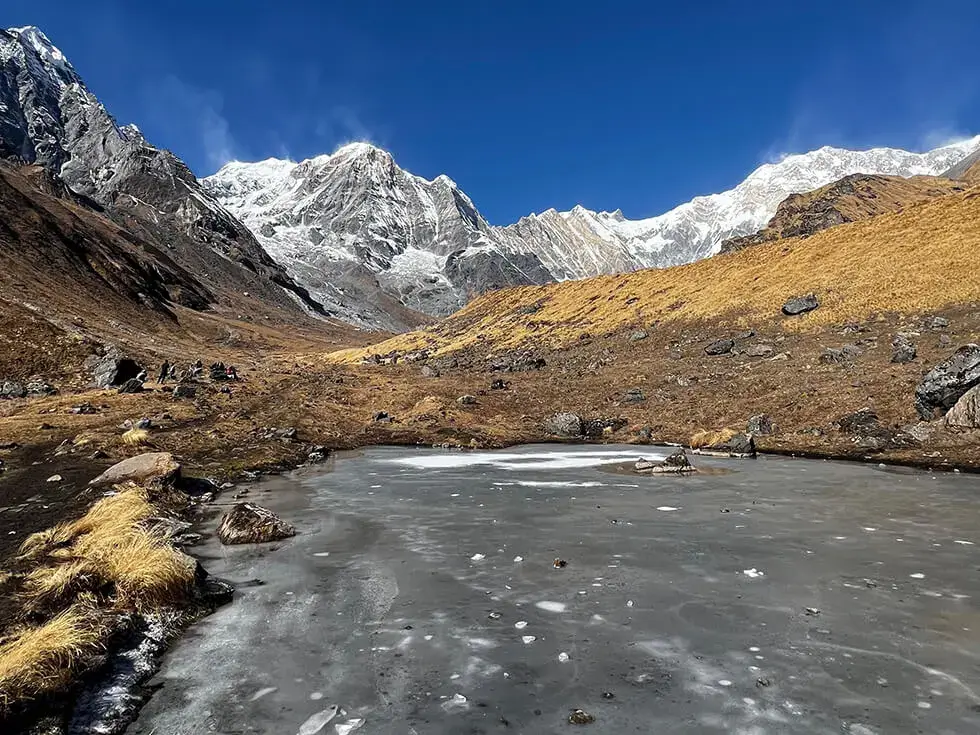
Small Ice Lake way to Annapurna base camp
3. Distance and Duration: How Much Time Do You Actually Have?
Annapurna Base Camp Trek
The distance of the trek is the deciding factor. ABC Trek’s total distance is 90 to 95 kilometres via poon hill and takes about 7-8 days total; the shorter ABC trek can be done in just 5 days from Pokhara to Pokhara. You can extend the trek if you like to spend more time in the mountains and if you want to take the trek in a more relaxing way, then you may add 1 or 2 days.Annapurna Circuit trek
The Circuit trek distance and duration vary depending on where you start and end. With road access, most of the trekkers start their trek from Dharapani or even Chame too. The trek and drive cover about 160 to 230 kilometres. The short itinerary is the Annapurna Circuit Trek: 10 days or 8 days. You may also combine Tilicho Lake or even Nar Phu Valley. This makes the trek longer. The Classical Annapurna Circuit Trek is now 13 days from Kathmandu to Pokhara because of the road drive to skip the trek on the Mustang side.
4. Difficulty: Which One Will Actually Difficult
The Annapurna Base Camp trek is “moderate,” and the Annapurna Circuit Trek is “moderate to challenging”, which means the Annapurna Circuit Trek is slightly harder than the Annapurna Base Camp Trek.
ABC’s trek difficulty lies in the trail structure and formations, not altitude. You’ll have to climb and descend many staircases. The trail is mostly covered with many staircases. Being a lower-altitude trek, it has a very low chance of getting AMS on the ABC trails, and trekkers also get enough acclimatisation because the trails do not allow trekkers to trek fast, which will help trekkers to acclimatise. Trekkers are required to trek

Evaluating your fitness for Annapurna Base Camp? While ABC reaches a lower maximum altitude than the Circuit, the steep stone staircases and rapid ascent profile present unique challenges. Explore our in-depth guide on Annapurna Base Camp Trek Difficulty for detailed terrain breakdowns, daily incline stats, and preparation advice.
The Circuit’s difficulty is a different level — it’s about continuous effort and endurance, discipline and determination. The trek is a combination of high elevations and vivid terrain trails. But it is not like in Base Frequent accents and descents; moreover, it is continuous ascents and descents. The most challenging part of the Annapurna Circuit is Thorong La Pass at 5,416 meters, and trekkers must wake up early at 4 am in the freezing temperatures. Altitude sickness may happen at Thorong La Pass, and you have to be careful while ascending

Need a deeper look at the physical demands? While comparing these two popular routes gives a great overall picture, crossing Thorong La Pass requires specific preparation. Read our comprehensive guide on the Annapurna Circuit Trek Difficulty for altitude breakdowns, daily walking hours, and training tips.
5. Route Style: Out-and-Back vs. Full Loop
The trek route trails are totally different. The ABC trek is to reach the base of the mountain and return via the same way, which means you will pass the same things twice, which trekkers may find not interesting because already seen them once, but some people still love that.
The Circuit trek circles the whole Annapurna massif, which means you will always explore new villages, whether it is a drive or a trek. This allows trekkers to enjoy the most diverse landscapes and the various mountain peaks along the long routes. The trek is good for people who love to explore and take pictures; the circuit trek is best
6. Cost Breakdown
Money matters, and the gap between these two treks is bigger than most people expect going in.
| Cost Category | ABC (5–10 days) | Circuit (10–14 days) |
|---|---|---|
| Guided package | $565–$755 (for 8 days) | $725–$950 (for 10 days) |
| ACAP permit | NPR 3,000 (~$20–25) | NPR 3,000 (~$20–25) |
| TIMS card (where applicable) | NPR 1,000–2,000 (~$8–20) | NPR 1,000–2,000 (~$8–20) |
| Guide (per day) | $25–$30 | $25–$30 |
| Porter (per day) | $20–$25 | $20–$25 |
| Teahouse accommodation | $5–$15/night | $5–$20/night (pricier near the pass) |
| Meals | $15–$25/day | $20–$40/day (higher in remote sections) |
| Domestic transport | Tourist Bus/Jeep to Ulleri or Banthanti | Bus/jeep to Besisahar, Jeep and flight option from Jomsom |
The Circuit and base camp trek both treks cost depends on the duration and transportationsmode that use on the trek. If the duration of the trek is higher, then the cost goes up and vice versa.
Comparing overall trek budgets? Permits, teahouse rates, jeep transportation, and itinerary lengths directly impact your total expenses. Check out our comprehensive budget breakdowns for the Annapurna Base Camp Trek Cost and the Annapurna Circuit Trek Cost to accurately plan your daily expenses, guide fees, and gear budget.
7. Permits You’ll Need
Nepal’s permit rules shift often enough that it’s worth double-checking closer to your travel dates, but here’s the current picture.
| Permit | Required For | Cost (Foreign Nationals) | Cost (SAARC Nationals) |
|---|---|---|---|
| ACAP (Annapurna Conservation Area Permit) | Both treks | NPR 3,000 (~$20–25) | NPR 1,000–1,500 |
| TIMS Card | Both, though enforcement has been inconsistent on popular routes | NPR 2,000 (~$15–20) | NPR 1,000 |
| Restricted Area Permit (Nar Phu, Manaslu, Tsum, etc.) | Only if adding a side valley | $100 for first 7 days, $15/day after | Same |
A licensed guide is now required by law, and people are still doing the trek free, but heaving guide is safe and ensures your trek safety.
8. Which Is Better: Annapurna Base Camp Trek or Annapurna Circuit Trek?
When it comes to a comparison between these two treks with various aspects such as scenery and landscape diversity, the Annapurna Circuit Trek (ACT) is the better choice. Unlike ABC, where the scenery is almost fixed as you see it from below, the Circuit the scenery differs almost every single day. Trekkers start their trek in a warm climate, then pass through alpine and reach tundra at Thorong La and again down to desert near Muktinath, and finish through the dramatic Kali Gandaki Gorge, the deepest gorge on Earth, between Mt Annapurna and Mt Dhaulagiri.
The Circuit also has more cultural experience than the ABC. You trek through Gurung villages in the lower hills, then Manangi and Tibetan-influenced settlements higher up, filled with village chortens, mani walls and very old monasteries, whereas in ABC you only see Gurung people and limited cultural experience.
Scenically, the Circuit trek is a great opportunity to see many peaks, including three peaks above 8,000 meters: Annapurna I (8,091m) from Kalapani and Lete, Dhaulagiri (8,167m), and Manaslu (8,163m, visible from Chame and Dharapani). Add to that the sense of achievement in crossing Thorong La Pass (5,416m) and the colourful landscapes after Thorong La are truly mesmerising.
That said, ABC is not “less beautiful” — it’s just a different kind of beautiful. ABC combines junglee walking in a lower area and from Deurali onward, then a sudden, close-up payoff as the Annapurna Sanctuary opens around you. From here you see Annapurna I (8,091m) at a very close distance, along with Annapurna South, Gangapurna, and the iconic fishtail-shaped Machapuchare. The sunrise over this himalayas are truly mesmerising. In the ABC Trek, you can have another of the best sunrise views from Poon Hill or Mulde View Point; this gives the most panoramic views of the entire Annapurna and Dhaulagiri range.
Despite ABC’s strong close-range views, the Annapurna Circuit gives trekkers a bigger overall scenic return — more diversified landscapes, more peaks to see including 8,000m peaks, more cultural variety, and a genuine high-altitude pass to summit — which is why, landscape-for-landscape, it’s the better trek of the two.
| Scenery Factor | Annapurna Base Camp (ABC) | Annapurna Circuit (ACT) | Winner |
|---|---|---|---|
| Landscape diversity | Forest → single alpine sanctuary | Subtropical valley → forest → high desert → alpine pass → Desert again | ACT |
| Number of 8,000m peaks visible | 1 (Annapurna I perfect view), Annapurna South, Gangapurna and Fishtail | 3 (Annapurna I from Far, Dhaulagiri from far, Manaslu from far) but many Annapurna II, III, IV, Gangapurna and many other peaks | ACT |
| Closest mountain views | Very close — inside the Annapurna Sanctuary | Farther, but wider panoramic spread | ABC |
| Cultural variety | Gurung villages only | Gurung, Manangi, and Tibetan Buddhist culture | ACT |
| Signature scenic reward | Poon Hill / Mulde View Point sunrise, Annapurna Sanctuary | Thorong La Pass crossing (5,416m), Kali Gandaki gorge | ACT |
| Scenic pace | Fast, concentrated payoff in fewer days | Gradual, ever-changing scenery over more days | Tie (depends on preference) |
| Jungle/forest walking experience | Lush bamboo and rhododendron forest from Deurali onward | Shorter forest sections lower down, less overall | ABC |
| Best for | Trekkers wanting maximum beauty in minimum time | Trekkers wanting maximum variety and scenic “return” | ACT overall |
Verdict: For the natural beauty per day in a short span of time, ABC beats the ACT, but when you have to combine the total scenery, landscape diversity, cultural exposure, and that experience to cross the Thorong La with the outstanding views of Manang and Mustang Valley, the Annapurna Circuit Trek comes out ahead as the more scenic and rewarding trek overall.
9. Best Time to Trek
The best time also can be the decision making factors of two treks, which is one less decision to stress over.
| Season | Conditions | Recommended For |
|---|---|---|
| March–May (Spring) | Mild temperatures, rhododendrons in bloom, some haze | Both treks, but in ACT, less forest |
| June–August (Monsoon) | Heavy rain, leeches, poor visibility | Avoid, but you may try your luck if you want to go anyway. |
| September–November (Autumn) | Clear skies, stable weather, peak crowds | Both treks — the most popular time with the best views |
| December–February (Winter) | Cold, snow at high elevation, fewer trekkers, but possible to do the ABC Trek and reach the base camp | Annapurna Circuit Trek: Thorong La Pass can be tough and closed because of the thick level of snow. Will be very cold |
10. Which Trek Fits You?
Pick ABC if: you have 5–12 days vacation in Nepal for the trek and want a moderate trek without high altitude, are travelling with family members or friends, then ABC is a good choice for you.
Pick the Circuit if: you have around 2 weeks and want dramatic landscape variety and to challenge yourself with the Thorong La Pass and see the most stunning diversified scenery; then ACT is a good option for you.
Can’t decide? If you have 3 weeks and want to explore both you can combine both or can ask us more about the trek and we will explain everything.
Frequently Asked Questions
11. Final Thought
The both trek is different and their experience are different. If your vacation days are short and and explore the moderate himalayan experience with the spectacular scenery then go for Annapurna base Camp Trek. If you have a 2 weeks and more time durations and challenge yourself to cross the thorong la pass and circle the Whole Annapurna Range and see 3 peaks above 8000 meters then you can choose the Annapurna Circuit Trek.
Ready to book your Himalayan adventure? Whether you choose the iconic amphitheatres of ABC or the dramatic high-pass crossing of Thorong La, Nepal Trek Hub provides customizable, safety-focused trekking logistics. Explore details and book directly on our Annapurna Base Camp Trek Package or Annapurna Circuit Trek Package pages.
